
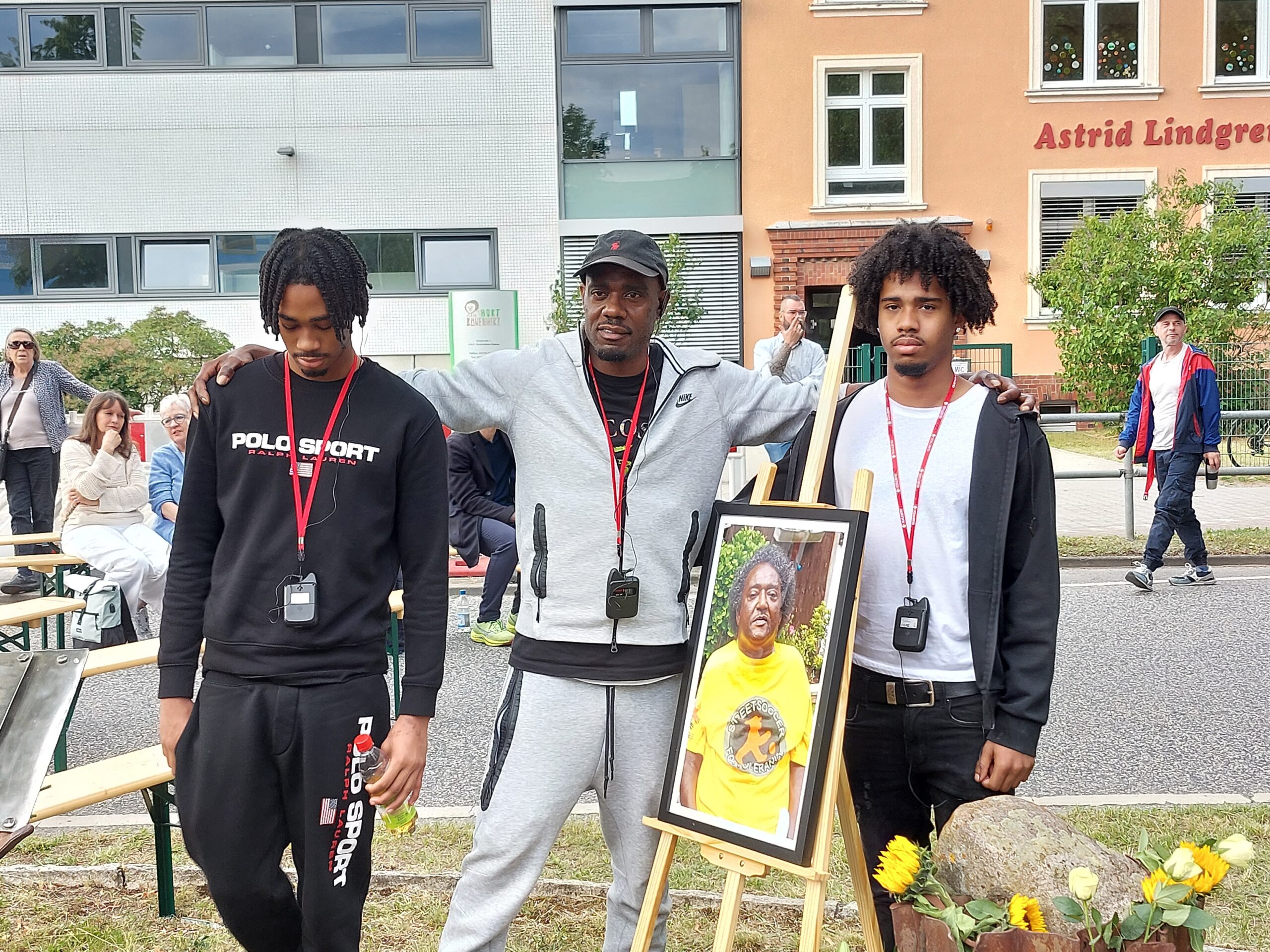
Opferperspektive: What motivated you to take part in the memorial rally on the occasion of the 30th anniversary of the attack and how did you and your sons experience it?
Negus Martin: My motivation was, first of all, being part of the Noël Martin Foundation — to keep my father’s memory alive, and to show my children the memory of their grandfather. It was also about showing support for the foundation and speaking out against racism.
The walk itself was overwhelming — very emotional for me. It was also amazing to see the support from the town and the people, with the mayor and the Minister-President of Brandenburg and other politicians coming out to show support, bear witness, and help get the word out.
My sons found it remarkable to see that their grandfather stands as a civil rights leader in the tradition of people like Martin Luther King, Bob Marley, Marcus Garvey, Rosa Parks — people who stood up for civil rights and freedom. It was very powerful for them to see that, and to know where it comes from.
When your father was attacked in Mahlow, you were about 17 years old. How did you experience what happened?
I was living in America at the time. I got the phone call about what happened to my father. And after a while I was able to talk to him — it was shocking, I couldn’t believe it. It felt so surreal.
I looked up to my father, as a very strong man, especially when he was walking — he was like a king to me, and he treated me like a prince. So when I heard about the tragedy, it just broke me apart. I just fell to pieces and cried.
When I was old enough, I said I’m coming to England to help and support him in the best way I could. And I’m doing that to this day.
What gave your father the strength to carry on after the attack?
You know what, I asked him that same question myself. His strength was amazing. There was a point where it was sad to see that he was about to give up. But then the birth of his grandchildren changed his mind. But not just that alone, though — it was also his drive to accomplish things, to overcome the odds, even in a situation where people expected he wouldn’t be able to do this.
In his wheelchair, he accomplished more than many able-bodied people ever could — his rental properties, his horse racing, his ability to see opportunities. It was amazing what he was capable of. His mind was very sharp.
The doctors said he’d only live 10 or 15 years after the injury, and he lived on for 24 years. I see that as amazing.
How do you perceive racism in society today?
Racism is a system put in place. Racism stops you from getting a job, it stops you from living where you want to live, from getting an education — there are a lot of roadblocks when it comes to racism. What we did in Mahlow was to try to tear those systems down. That’s why it was so powerful for me to witness the town coming together and marching in my father’s name.
My father was full of wisdom. In one of our conversations he once said to me: „Bricks in the world are the same – the construct of racism is the same. And one must become an engineer or an architect to change the social engineering.”
How do you look into the future?
I always look to the future with hope — you have to, because this is the future your children have to grow up in. You can’t give up on hope — if you give up on hope, you have nothing left.
From my own experience — seeing racism and exclusion as a child, and then seeing things change in society for my children — they don’t face the same roadblocks I had. And the roadblocks my father had, I didn’t have. It is changing – but it is slow. It’s a slow process, but we’ll get there.
Your father founded the “Noël and Jacqueline Martin Foundation.” It promotes exchanges between young people from England and Germany. What can you tell us about it?
It’s a beautiful thing, because it gives young people the chance to integrate with others — meeting new people, new cultures, learning different languages. Difference is not a weakness, it’s a strength.
It means a lot to me to keep my father’s legacy alive — I’m overwhelmed that they made me part of this charity, to carry it forward and to honor him.
What experiences of your visit to Germany will you keep in your memory?
When I arrived in Mahlow this year, I came by train from the airport, talking with someone. I just looked up and glanced out the window when we passed the Noël Martin Bridge. I hadn’t even realized it was there. Then I saw the graffiti on the concrete pillar: ‘Rest in Peace Noël Martin’. It gave me goosebumps. It was just a brief moment, but it moved me deeply; it was a sign.
I have so many memories — this is my third trip to Germany. The first time was in 2007. It was overwhelming, I was so well received — I still tell people about it to this day. I met a lot of great people who I’m still in touch with — people who are still fighting on. It’s good to see.
The second time was around 2021, after a bridge in Mahlow was named after my father — the Noël Martin Bridge.
What really moved me was learning how the school in Mahlow has integrated my father’s story into their curriculum, how the children learn about him. That was so touching to see.
It’s been really powerful to see that this town, Mahlow, has kept my father in their memory after all these years. It’s powerful to know that this town won’t forget.
Is there anything else you’d like to say to the people of Mahlow or the readers of this interview?
To the people of Mahlow and everywhere else, I would like to say: let’s keep the memory of my father, Noël Martin, and all the victims of racism and right-wing violence alive. We must never give up — the fight against racism continues.